A useful youth strength training program PDF should give your child an age-appropriate, supervised routine using body weight, bands, or light equipment, with clear warm-up, rest, modification, and progression guidance.
What should you check before choosing a youth strength training PDF?
Choose a PDF that offers a structured, printable routine rather than a random collection of exercises. Parents often search for a youth strength training program PDF because they want to know what to do first, how long to practice, and how to keep a child moving safely.
Before downloading, confirm that the resource names an intended age or experience level and explains when a parent, coach, or qualified professional should supervise. Look for exercise demonstrations, warm-up and cool-down instructions, rest periods, resistance recommendations, and modification options. A short checklist can help you screen a resource quickly:
- Age and level: The routine identifies who it suits.
- Safety: It explains supervision, space, equipment, and warning signs.
- Instruction: Each movement includes setup, technique, breathing, and common errors.
- Progression: It explains how to adjust difficulty without chasing maximum loads.
Match the resource to your child
Match the PDF to your child’s age, movement experience, interests, and current comfort with activity. A routine written for experienced young athletes may be unsuitable for a child who is just learning squats, planks, or wall push-ups.
Choose guidance that allows easier versions and encourages an adult to watch the first sessions. Children with an injury, health condition, or exercise-related symptoms should receive appropriate medical guidance before starting.
Check whether instructions are complete
A well-designed PDF explains the starting position, movement path, breathing, repetitions or time, rest, and stopping points for every exercise. Precise instructions matter because a picture alone may not show how to keep knees, shoulders, or the spine positioned.
Also check whether the document explains equipment substitutions and tells families what to do if technique declines. A printable page is useful only when your family can understand and apply it without guessing.
How can you compare body weight, resistance bands, and light equipment?
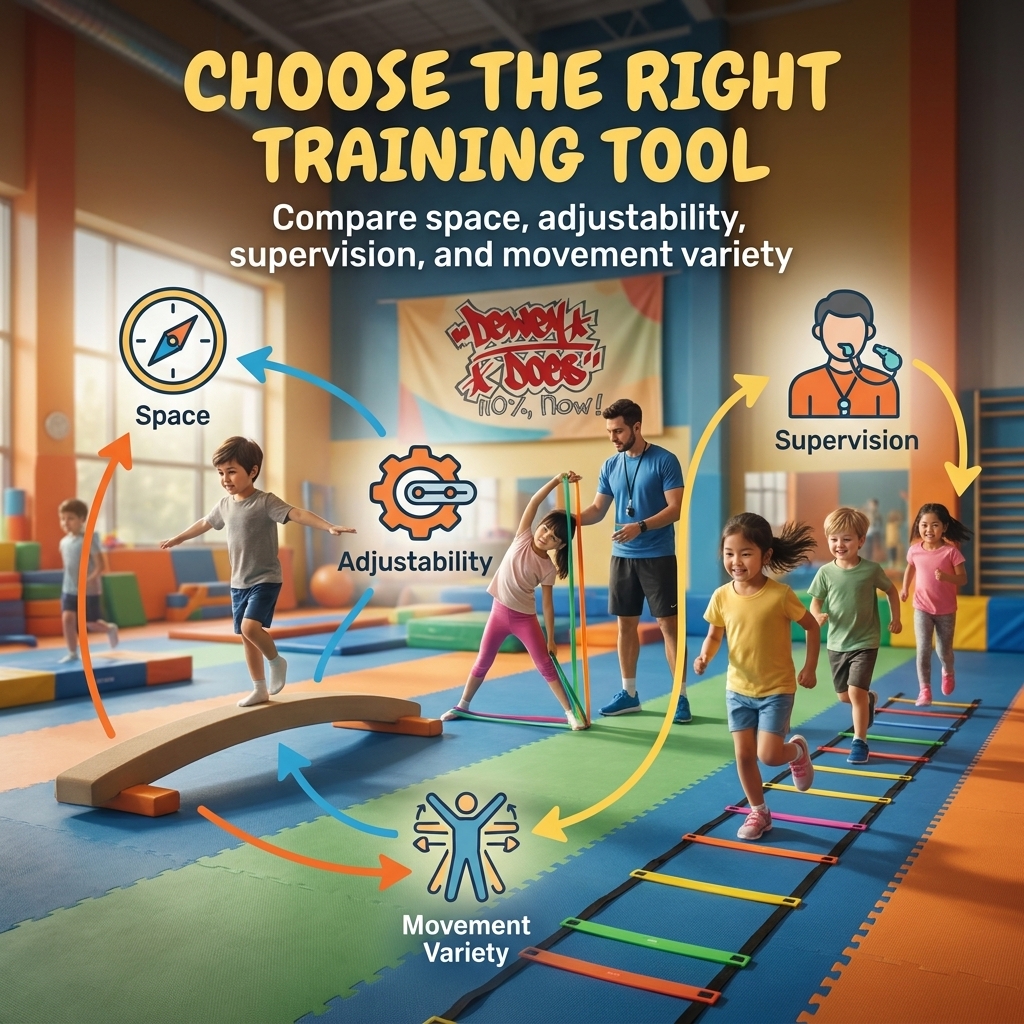
Comparison graphic showing body weight, resistance bands, and light equipment for youth exercise
Body weight is usually the simplest starting point, bands add compact adjustable resistance, and light equipment can provide variety when an adult can monitor technique. Compare each option by space, portability, learning curve, adjustability, and the type of resistance it provides.
Body-weight exercises need little equipment and can work in a clear home area. Suitable examples may include squats, wall push-ups, step-ups, planks, and controlled lunges when the movement matches the child’s ability. Bands are portable and can change the challenge through band tension, range of motion, or body position. They require secure anchoring, controlled movement, and a band that is not too difficult to manage.
Light dumbbells, soft medicine balls, or carefully chosen household alternatives may add variety, but only when the PDF gives clear instructions and an adult can observe form. More equipment does not automatically create a better youth strength routine.
Body-weight movements for simple home sessions
Body-weight movements can build a useful foundation because children can focus on balance, posture, and controlled movement before managing external resistance. A chair-assisted squat, wall push-up, step-up, short plank, or partial-range lunge can be adjusted to the child’s skill.
Keep the area uncluttered and choose a surface that supports stable footing. The adult should watch for rushed repetitions, uncomfortable joint positions, breath-holding, or loss of balance.
Bands and light equipment for gradual variety
Resistance bands and light equipment can add variety after a child understands the movement pattern. Begin with low challenge, keep bands away from the face, inspect them for damage, and avoid anchoring them to an unstable object.
For dumbbells or soft medicine balls, use only the load and movement described by the program. The child should be able to control the equipment through the full planned movement without swinging, straining, or losing posture.
What should a safe youth strength session include from warm-up to cool-down?
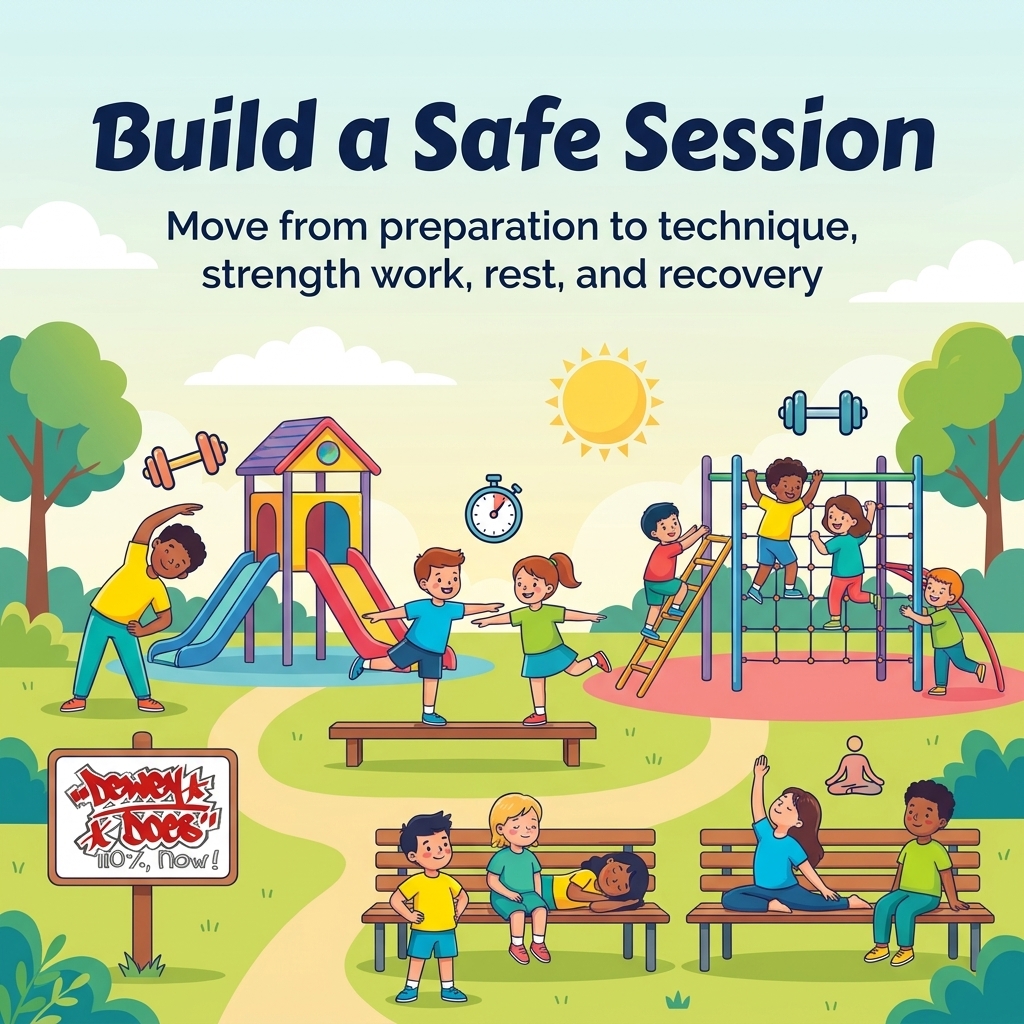
Five-step youth strength session sequence from warm-up through cool-down
A practical session should move from easy activity to dynamic warm-up, technique practice, strength exercises, rest intervals, and a gradual cool-down. This sequence helps the child prepare, practice, work at a manageable level, and finish calmly.
A useful PDF should state how many rounds, repetitions, or timed intervals to attempt, but those numbers are not universal prescriptions. The right amount depends on age, experience, other sports, recovery, and the child’s ability to maintain form. Pause when technique declines, breathing becomes difficult, or the child reports pain, dizziness, or unusual discomfort. Normal effort can include warmer muscles and heavier breathing; sharp pain, faintness, or persistent discomfort requires stopping and appropriate medical advice.
Prepare the body with age-appropriate movement
Start with easy movement such as walking, marching, or gentle whole-body activity, then use dynamic movements that resemble the planned exercises. Practice one or two technique repetitions before beginning the main set so the child understands the position and pace.
A warm-up should prepare rather than exhaust the child. Keep instructions simple, demonstrate each movement, and choose a routine that feels approachable rather than competitive.
Build in rest and recovery
Rest periods should be long enough for the child to regain control, breathe comfortably, and repeat the movement with sound technique. The PDF should identify pauses between exercises and make room for extra rest when needed.
Recovery also includes days away from structured strength work and attention to other activities. If a child has an injury, health condition, or symptoms during exercise, ask a qualified medical professional how to proceed.
How should children progress without chasing maximum loads?
Progress should improve posture, balance, controlled tempo, confidence, and enjoyment before it increases resistance. Youth strength training should not copy adult-style maximum-load goals, especially when a child is still learning movement skills.
Progress one variable at a time, and keep the child able to demonstrate consistent technique. A sensible sequence is:
- Learn: Practice the movement with a stable setup and comfortable range.
- Control: Slow the tempo and repeat the same pattern with steady breathing.
- Build: Add a small number of repetitions, a little range of motion, or another manageable round.
- Adjust: Introduce modest resistance only when technique remains consistent.
- Review: Keep the easier version available whenever fatigue or discomfort appears.
Prioritize technique before resistance
Technique comes before resistance because a child needs control to use a band, dumbbell, or medicine ball safely. Watch for a stable starting position, smooth movement, regular breathing, and the ability to stop without losing balance.
If the child rushes, holds their breath, or changes posture to finish, reduce the challenge. A shorter, well-controlled set is more useful than a heavier or longer set performed poorly.
Use simple modifications
Useful modifications include chair-assisted squats, wall push-ups, shorter plank holds, reduced band tension, smaller ranges of motion, and extra rest. These choices help children participate while learning what the movement should feel like.
Change only one factor at a time and let the child practice the easier version until it feels consistent. The goal is a manageable challenge that supports confidence and family physical activity.
Which PDF features make a program practical for everyday family use?
The most practical PDFs explain each exercise clearly and show how the routine fits a real family schedule. Look for a clear exercise name, visual demonstration or precise description, starting position, movement cues, breathing guidance, and common errors to avoid.
The document should identify required equipment, available substitutions, session length, suggested frequency, rest days, and ways to scale movements for different ability levels. Test a short session in a safe, uncluttered area and note which exercises feel clear, enjoyable, and manageable. Comfortable active clothing can support free movement, so families may also find our guide to choosing children’s activewear for everyday play useful.
Look for clear demonstrations and printable planning
Clear demonstrations reduce guesswork, while a printable plan helps the child see the session’s beginning, middle, and end. Favor pages that show setup and finish positions, not just the name of a movement.
It also helps when a PDF leaves space to record the chosen modification, rest time, or movement that needs more practice. Keep the plan simple enough for a parent and child to review together.
Fit the routine to your home and schedule
Choose a routine that fits the available floor space, equipment, supervision, and family schedule. A short session that can be completed safely is more practical than a longer plan that regularly gets interrupted.
Clear the area before starting, keep water nearby, and avoid using equipment that the child cannot control. Active clothing may support comfortable movement, but it is not required for a safe session.
What should parents do after downloading a youth strength training program?
Begin with a supervised, conservative first session: read the PDF together, clear the exercise area, prepare water, demonstrate each movement, and stop if technique or comfort deteriorates. Treat the first session as a test of clarity and fit, not a performance challenge.
Invite the child to choose an attainable goal, such as learning one movement, completing a short circuit, or joining a family activity. Dewey Does supports active lifestyles through children’s activewear, educational materials, and a family-oriented mission, but no product is required to exercise. Families can browse the Dewey Does Store for activity-focused resources and apparel.
Run a supervised first session
A parent or responsible adult should demonstrate each movement, check the space, and watch the child’s technique throughout the first session. Start with the easiest listed variation, use the stated rest guidance, and stop when form, breathing, or comfort worsens.
Afterward, ask which movements felt clear and enjoyable. Use that feedback to select modifications before repeating the routine.
Make activity part of family life
Family activity works best when it feels attainable and encouraging rather than like a test. A walk, active game, movement break, or short strength circuit can reinforce the same goals of confidence, healthy habits, and childhood obesity prevention.
For an educational activity, the I Love My Dewey Does Sports Fitness Coloring Book costs $8.99 and encourages healthy lifestyles and teamwork. Every purchase supports the Dewey Does Foundation’s work promoting literacy and active lifestyles for children.
Frequently Asked Questions
Is a youth strength training PDF suitable for every child?
A PDF is only a starting resource, not a universal plan for every child. Check its age guidance, exercise level, supervision advice, and modification options, and seek medical or qualified coaching guidance for a child with an injury, health condition, or symptoms during exercise.
Are body-weight exercises enough for a youth strength routine?
Body-weight movements can provide a useful foundation when children use controlled technique and age-appropriate variations. Bands or light equipment may add variety later, but more resistance is not automatically better.
How often should a child follow a strength training program?
The right schedule depends on the child, the routine, other sports, recovery, and qualified adult guidance. Choose a PDF that explains rest periods, and do not increase frequency or difficulty while the child is fatigued or losing form.
What equipment does a family need to begin?
Many introductory routines require only body weight and a safe amount of floor space. If a program uses bands or light equipment, confirm that it gives resistance guidance, safe-use instructions, and practical substitutions.
How do parents know whether a youth strength PDF is well designed?
Look for age and ability guidance, demonstrations, warm-up and cool-down directions, rest instructions, modifications, progression rules, equipment details, and clear safety reminders. A strong resource helps your family act without guessing.
#DeweyDoes #AMonsterAteMySneakers #YouthSports #Kidsbooks #Childrensliteracy